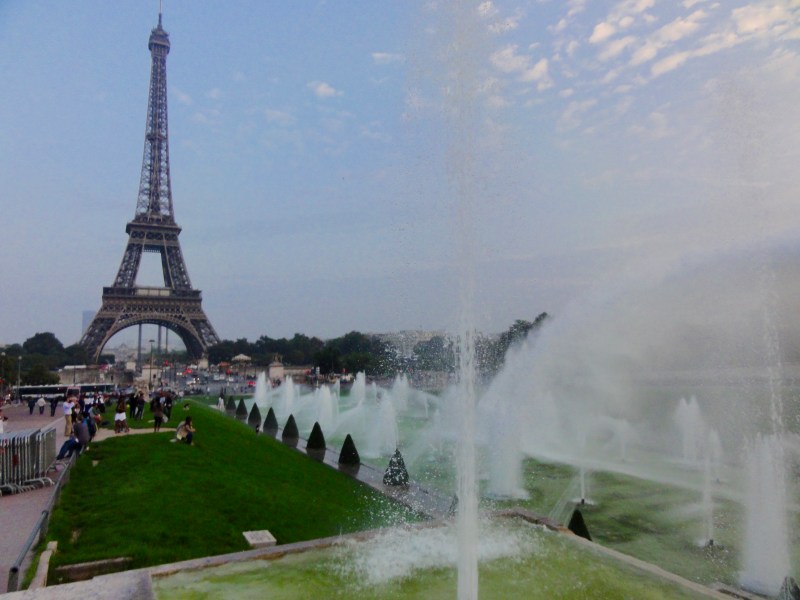
Starting point: Eiffel Tower
The Eiffel Tower (French: Tour Eiffel) is a wrought iron lattice tower named after the engineer Gustave Eiffel, whose company designed and built the tower. Constructed in 1889 as the entrance to the 1889 World’s Fair, it was initially criticized by some of France’s leading artists and intellectuals for its design, but it has become a global cultural icon of France and one of the most recognisable structures in the world. The tower is about the same height as an 81-story building and is the tallest structure in Paris.
The tower has three levels for visitors, with restaurants on the first and second levels.

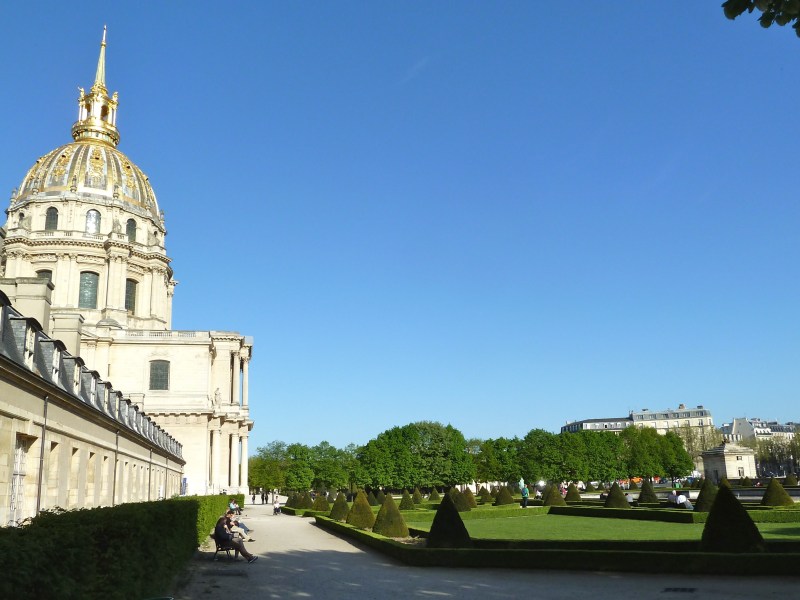
Les Invalides
Les Invalides is a complex of buildings containing museums and monuments, all relating to the military history of France, as well as a hospital and a retirement home for war veterans, the building’s original purpose. The buildings house the Musée de l’Armée, the military museum of the Army of France, the Musée des Plans-Reliefs, and the Musée d’Histoire Contemporaine, as well as the Dôme des Invalides, a large church with the burial site for some of France’s war heroes, most notably Napoleon Bonaparte.
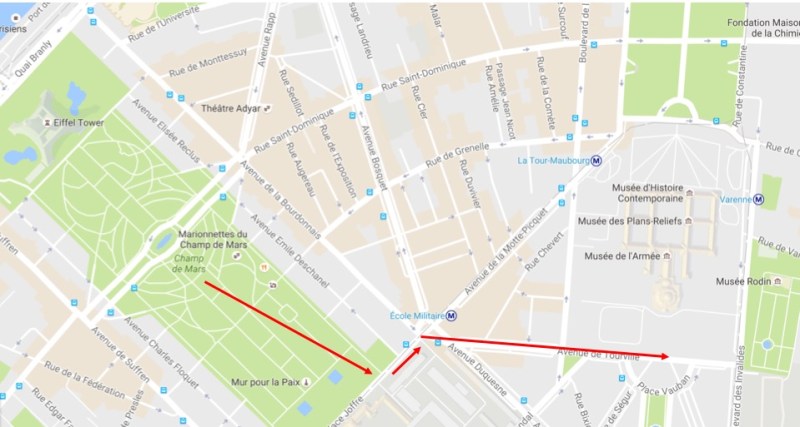
Directions: Walk to the northeast corner of Champ de Mars. Turn left on Place Joffre and right on Avenue de Tourville. Les Invalides is on your left.
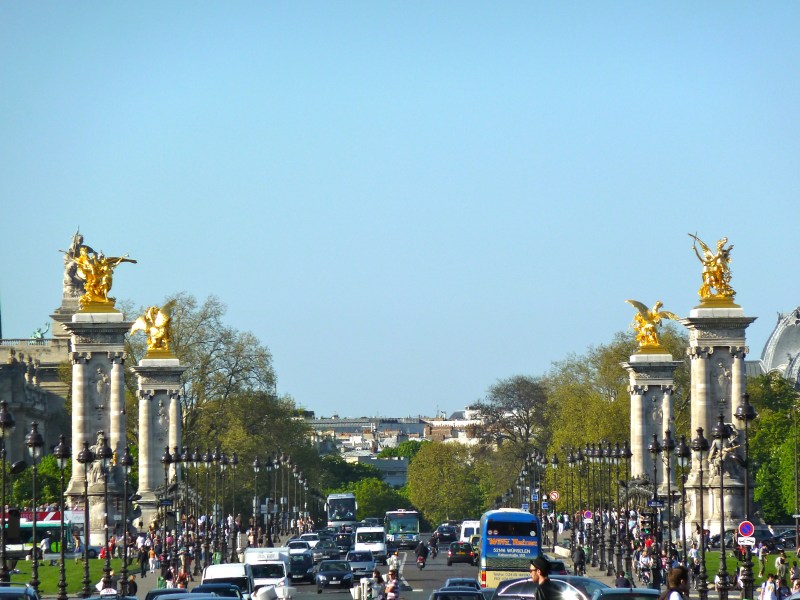
Pont Alexandre III
The Pont Alexandre III (English: Alexander III bridge) is a deck arch bridge that spans the Seine in Paris. It connects the Champs-Élysées quarter with those of the Invalides and Eiffel Tower. The bridge is widely regarded as the most ornate, extravagant bridge in the city. The Beaux-Arts style bridge, with its exuberant Art Nouveau lamps, cherubs, nymphs and winged horses at either end, was built between 1896 and 1900. It is named after Tsar Alexander III, who had concluded the Franco-Russian Alliance in 1892. His son Nicholas II laid the foundation stone in October 1896.
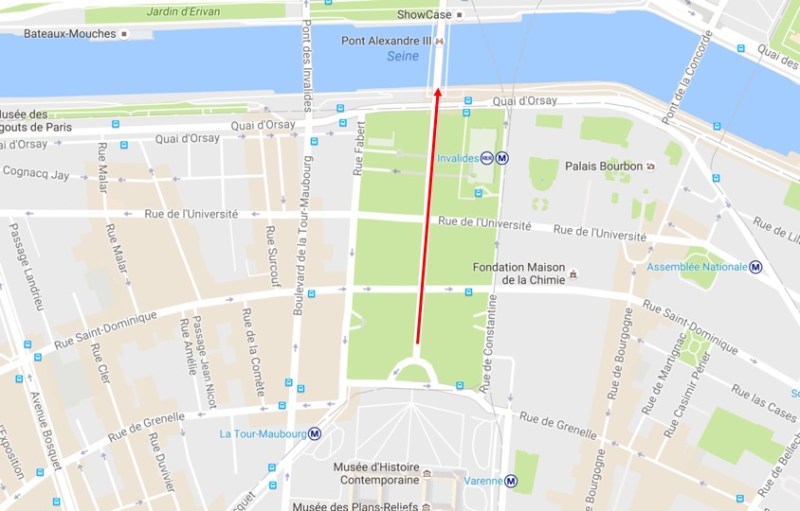
Directions: From the northern side of Les Invalides, walk straight ahead through the Esplanade des Invalides which will take you directly to the Pont Alexandre III.
Arc de Triomphe
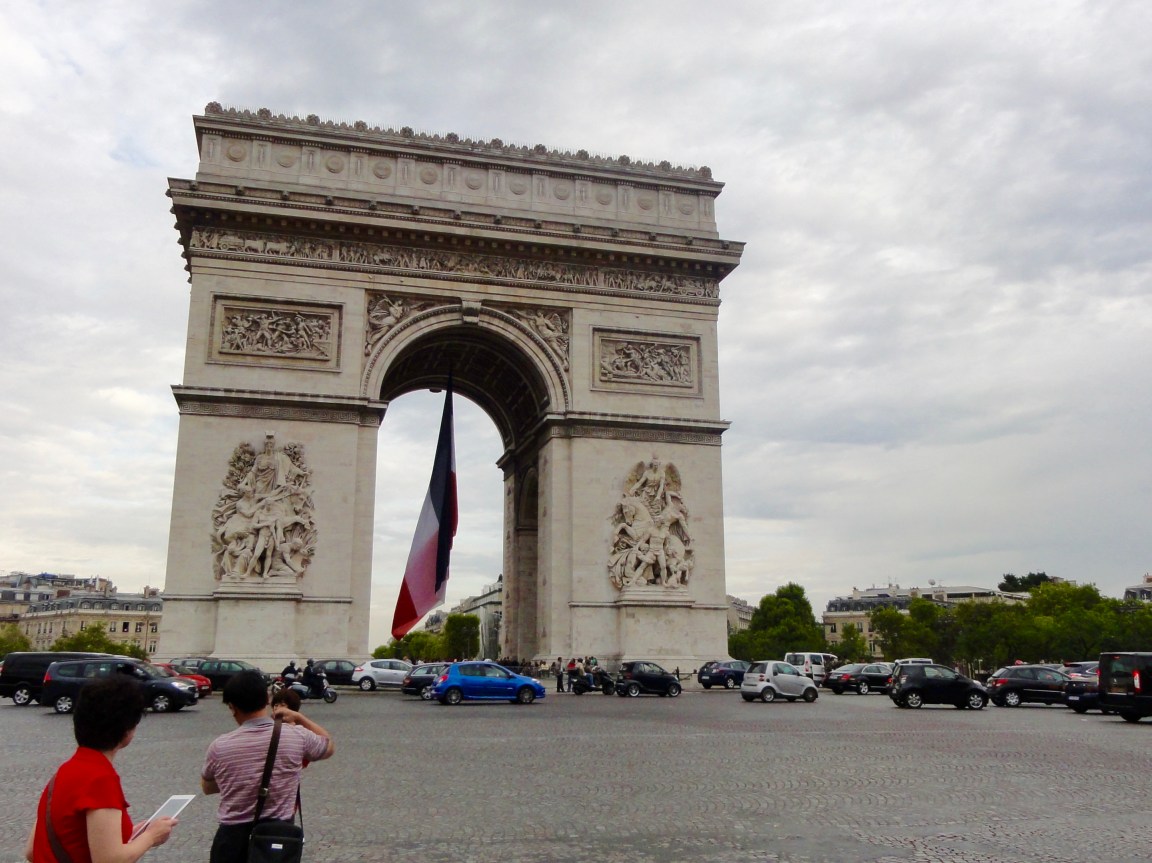
The Arc de Triomphe de l’Étoile (English: Triumphal Arch of the Star) is one of the most famous monuments in Paris. It stands in the centre of the Place Charles de Gaulle (originally named Place de l’Étoile), at the western end of the Champs-Élysées. It should not be confused with a smaller arch, the Arc de Triomphe du Carrousel, which stands west of the Louvre. The Arc de Triomphe honours those who fought and died for France in the French Revolutionary and the Napoleonic Wars, with the names of all French victories and generals inscribed on its inner and outer surfaces. Beneath its vault lies the Tomb of the Unknown Soldier from World War I.
Directions: From Pont Alexandre III, continue forward past the Grand Palais. Enter the subway at the Champs-Élysées – Clemenceau stop. Take the 1 line three stops to the Charles de Gaulle Étoile stop.

Champs-Élysées
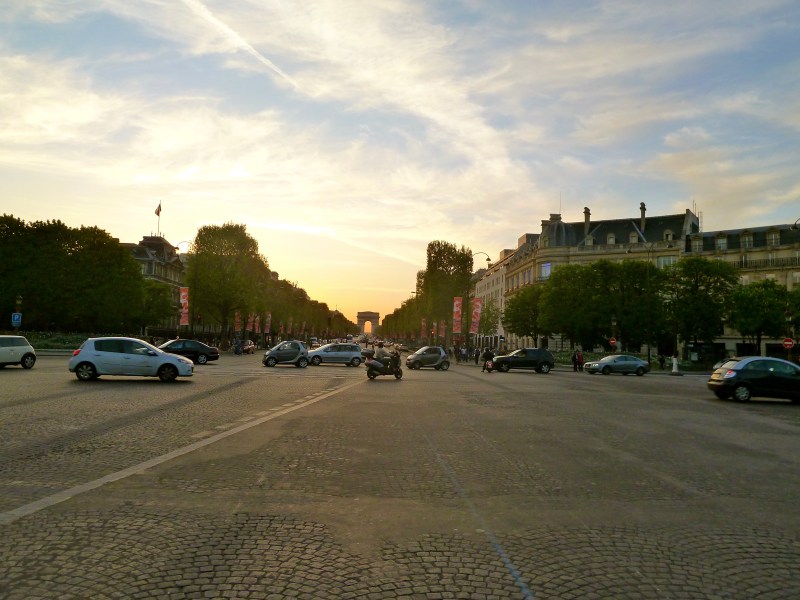
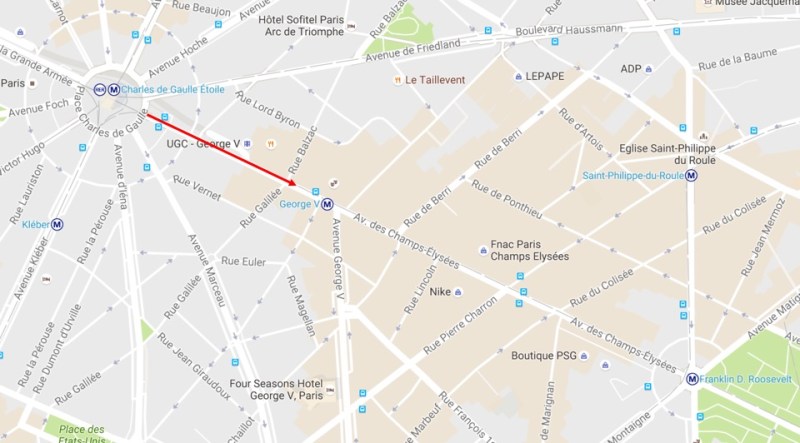
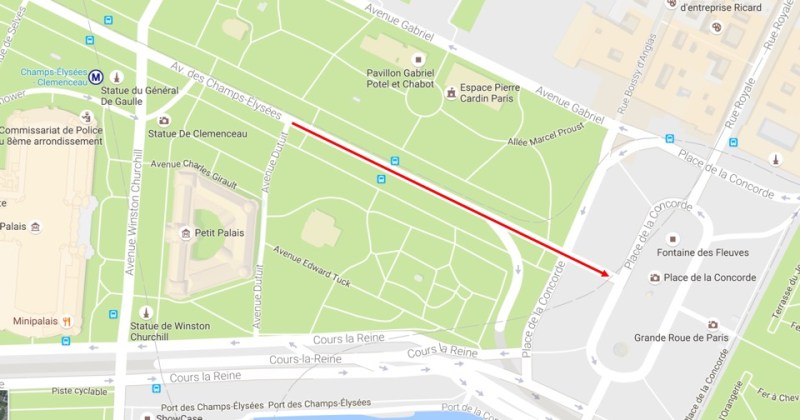
The Avenue des Champs-Élysées is a boulevard running between the Place de la Concorde and the Place Charles de Gaulle, where the Arc de Triomphe is located. It is known for its theatres, cafés and luxury shops, for the annual Bastille Day military parade, and as the finish of the Tour de France cycle race.
Place de la Concorde
The Place de la Concorde is the largest square in the Paris. It was designed in 1755 and named Place Louis XV to honor the king at that time. During the French Revolution the statue of Louis XV of France was torn down and the area renamed Place de la Révolution. The new revolutionary government erected the guillotine in the square, and it was here that King Louis XVI and Queen Marie Antoinette were executed in 1793. In 1795, under the Directory, the square was renamed Place de la Concorde as a gesture of reconciliation after the turmoil of the French Revolution.
The center of the Place is occupied by a giant Egyptian obelisk decorated with hieroglyphics exalting the reign of the pharaoh Ramesses II. It is one of two the Egyptian government gave to the French in the 19th century. The obelisk once marked the entrance to the Luxor Temple.
The two fountains in the Place de la Concorde are on the theme of rivers and seas. The north fountain was devoted to the Rivers, with allegorical figures representing the Rhone and the Rhine, the arts of the harvesting of flowers and fruits, harvesting and grape growing; and the geniuses of river navigation, industry, and agriculture. The south fountain, closer to the Seine, represented the seas, with figures representing the Atlantic and the Mediterranean; harvesting coral; harvesting fish; collecting shellfish; collecting pearls; and the geniuses of astronomy, navigation and commerce.
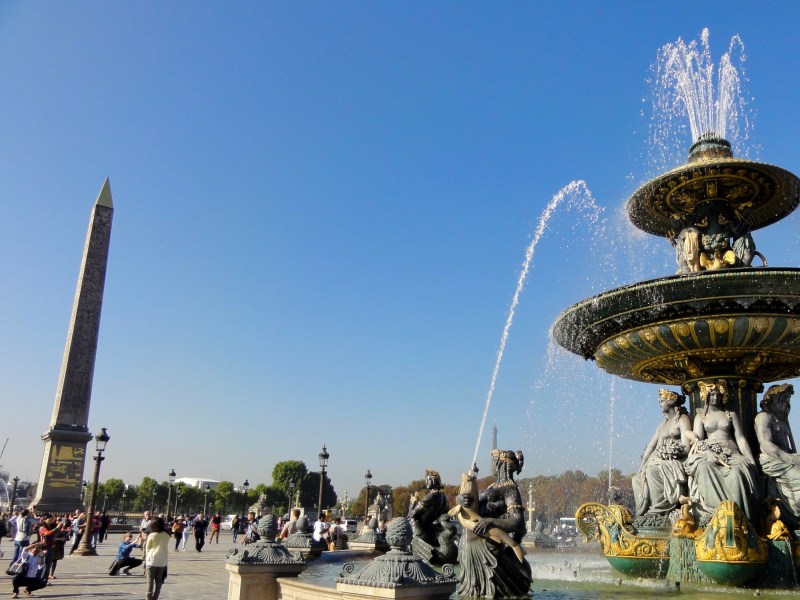
Directions: Place de la Concorde is located at the end of the Champs-Élysées, opposite the Arc de Triomphe.
Tuileries Garden
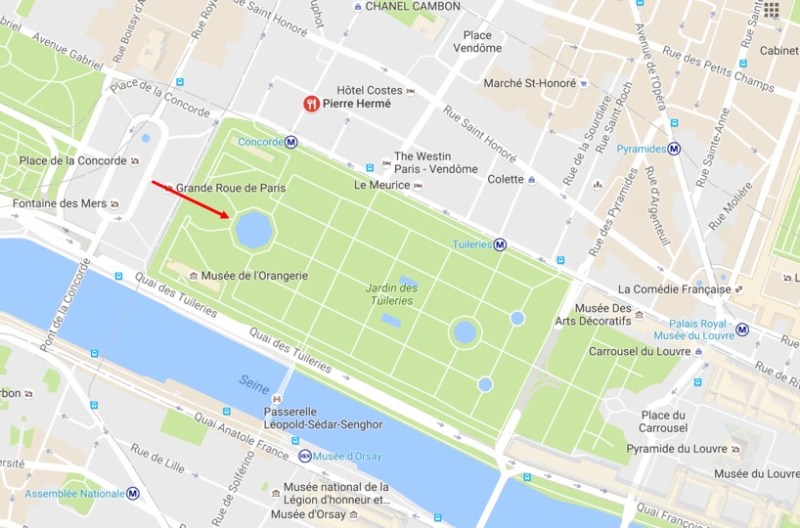
The Tuileries Garden (French: Jardin des Tuileries) is a public garden located between the Louvre Museum and the Place de la Concorde. Created by Catherine de Medici as the garden of the Tuileries Palace in 1564, it was eventually opened to the public in 1667, and became a public park after the French Revolution.
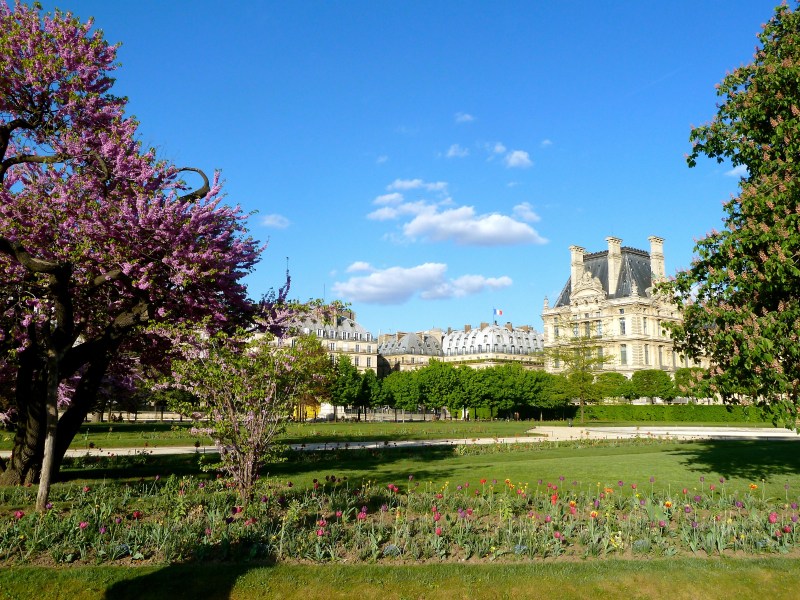
Directions: The Tuileries Garden is located on the side of the Place de la Concorde opposite of the Champs-Élysées.
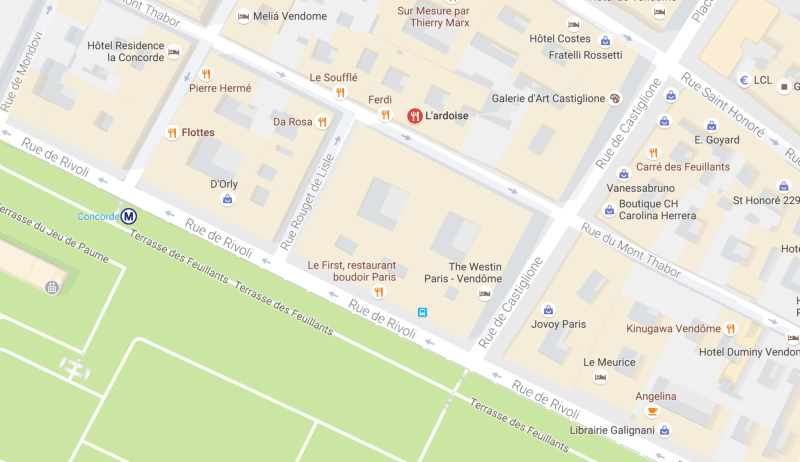
L’Ardoise (dinner)

 Eternal Horizon