Starting point: Barrage Vauban
The Barrage Vauban, or Vauban Dam, is a bridge, weir and defensive work erected in the 17th century on the River Ill. At that time, it was known as the Great Lock (grande écluse), although it does not function as a navigation lock in the modern sense of the word. Today it serves to display sculptures and has a viewing terrace on its roof, with views of the earlier Ponts Couverts bridges and Petite France quarter. The barrage was constructed from 1686 to 1690 in pink Vosges sandstone for the principal defensive function to enable, in the event of an attack, the raising the level of the River Ill and thus the flooding of all the lands south of the city, making them impassable to the enemy. This defensive measure was deployed in 1870, when Strasbourg was besieged by Prussian forces during the Franco-Prussian War, and resulted in the complete flooding of the northern part of the suburb of Neudorf.

Petite France
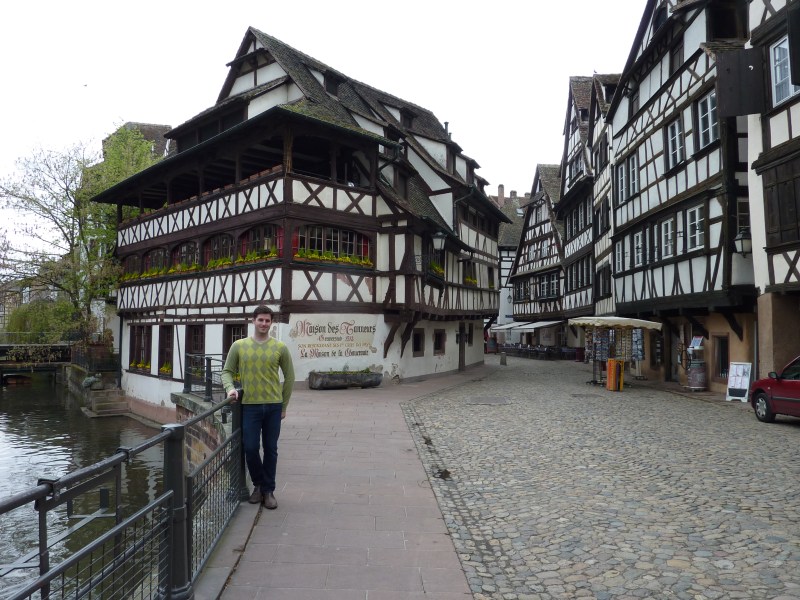
Petite France is a historic quarter of the city of Strasbourg in eastern France. It is located at the western end of the Grande Île, which contains the historical centre of the city. At Petite France, the River Ill splits up into a number of channels that cascade through an area that was, in the Middle Ages, home to the city’s tanners, millers and fishermen, and is now one of Strasbourg’s main tourist attractions. Petite France forms part of the UNESCO World Heritage Site of Grande Île, designated in 1988. The name Petite-France (“Little France”) was not given for patriotic or architectural reasons. It comes from the “hospice of the syphilitic” (Hospice des Vérolés, in French), which was built in the late fifteenth century on this island, to cure persons with syphilis, then called Franzosenkrankheit (“French disease”) in German.
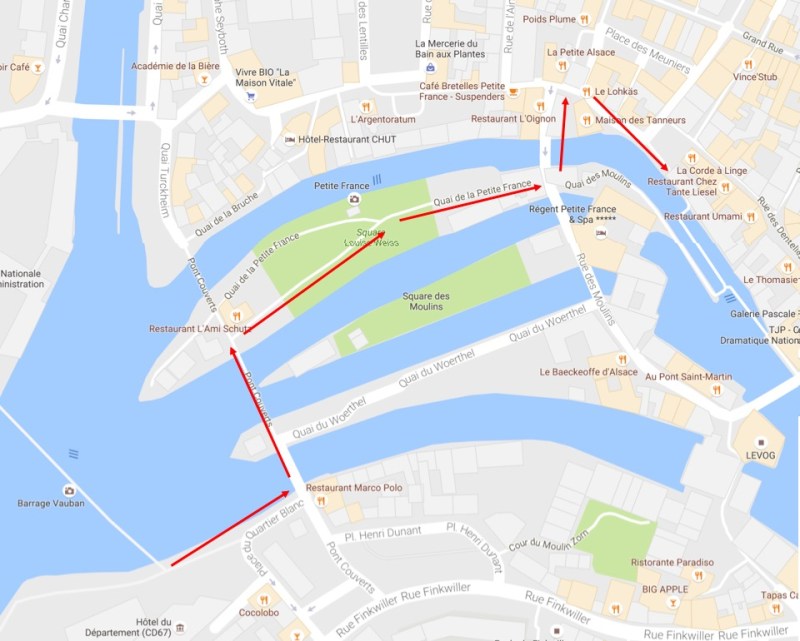
Directions: From the bridge, take a left and walk along the water towards Place de Quartier Blanc. Take a left on Pont Couverts and a left on Quai de la Petite France. Turn left on Rue des Moulins and right on Rue du Bain aux Plantes.
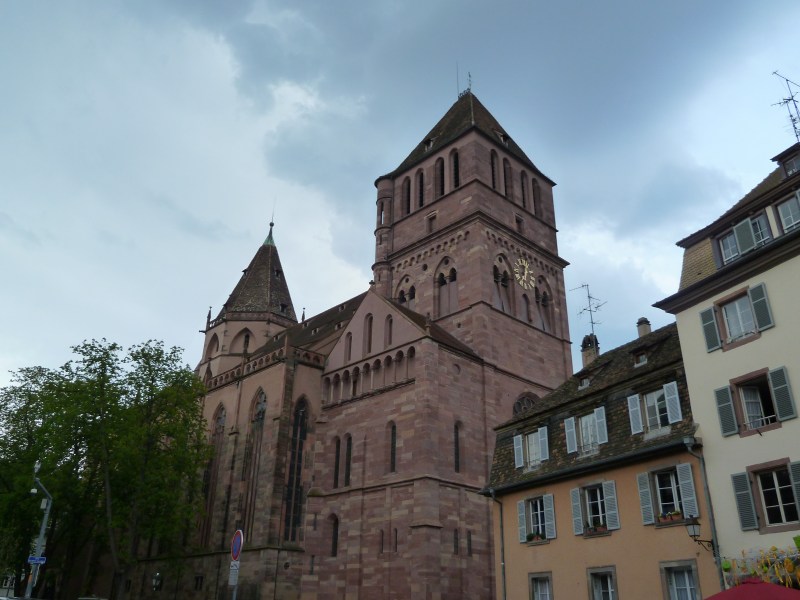
Saint Thomas Church
The church of St. Thomas (French: Église Saint-Thomas, German: Thomaskirche) is the main Lutheran church of the city since its Cathedral became Catholic again after the annexation of the town by France in 1681.
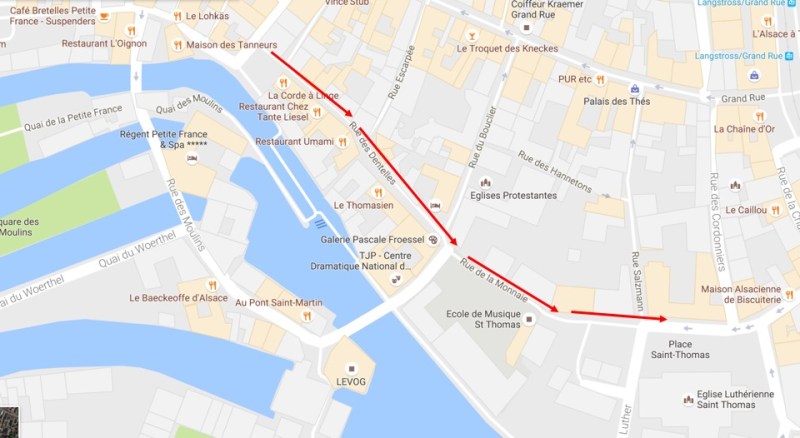
Directions: From Rue du Fossé des Tanneurs, walk down Rue des Dentelles and follow the street as it curves and turns into Rue de la Monnaie.
Place Gutenberg
In the center of the square stands the statue of the German printer Johannes Gutenberg , holding in his hands a scroll which says, “And there was light.” The main building bordering the square is the Neue Bau , the former City Hall of Strasbourg and current Chamber of Commerce and Industry of the Bas-Rhin. In December, a Christmas market is held on the square.
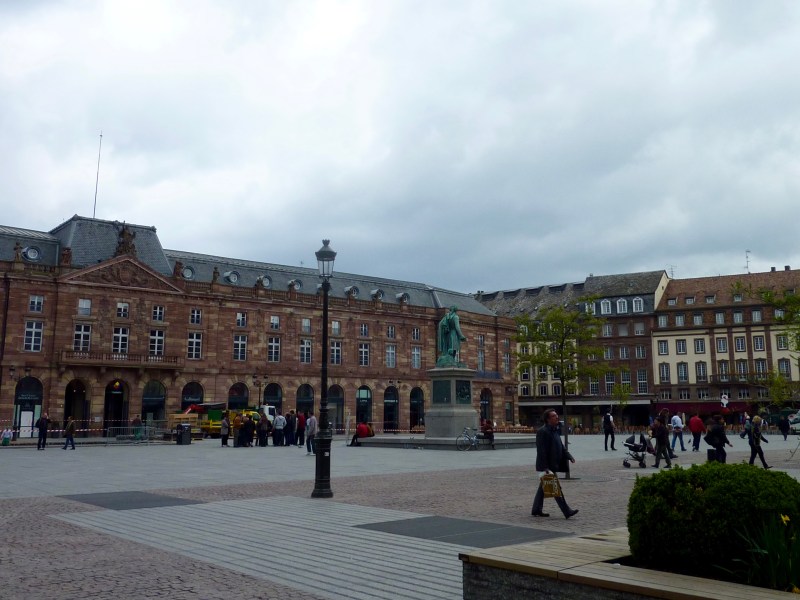
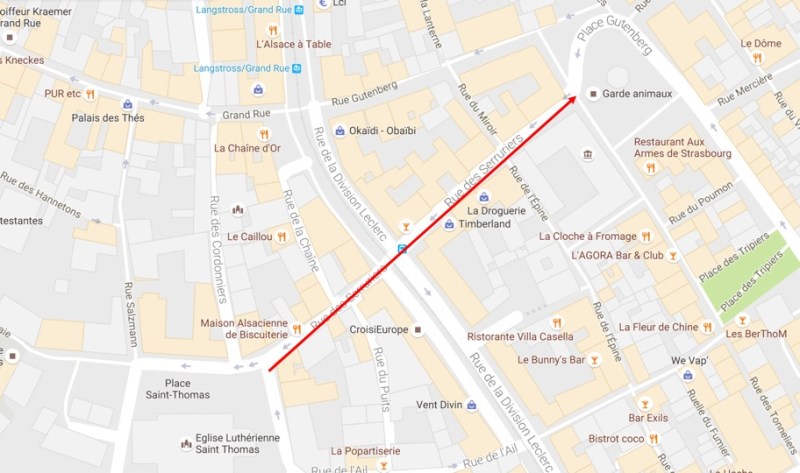
Directions: From Eglise Saint Thomas, walk u Rue des Serruriers.
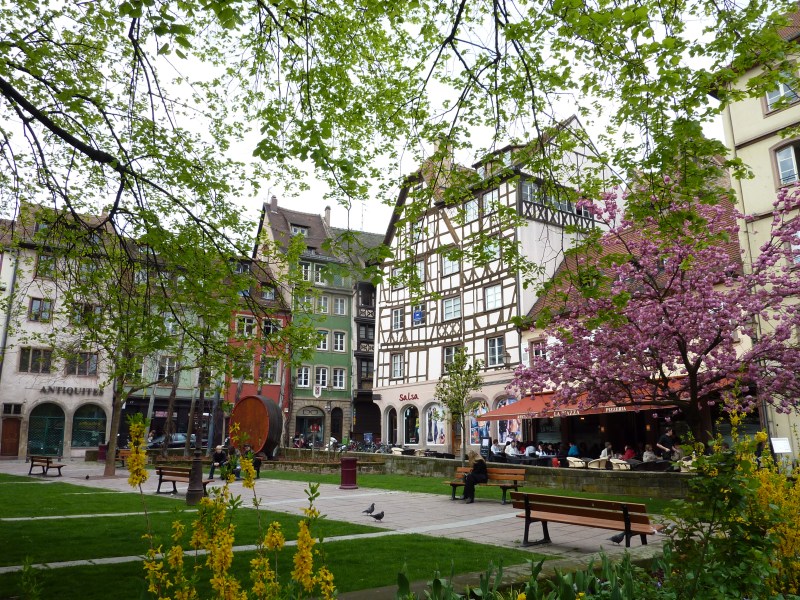
Place de Trippiers
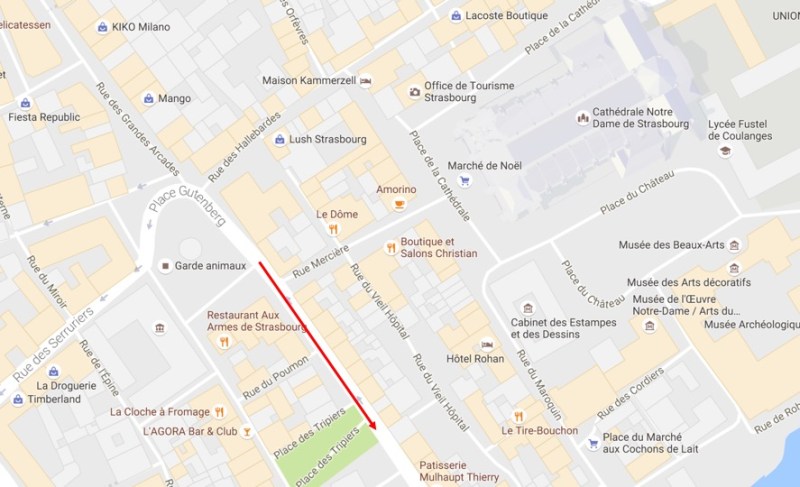
Directions: From Place Gutenberg, walk down Rue du Vieux Marché aux Poissons.
Place de la Cathedrale
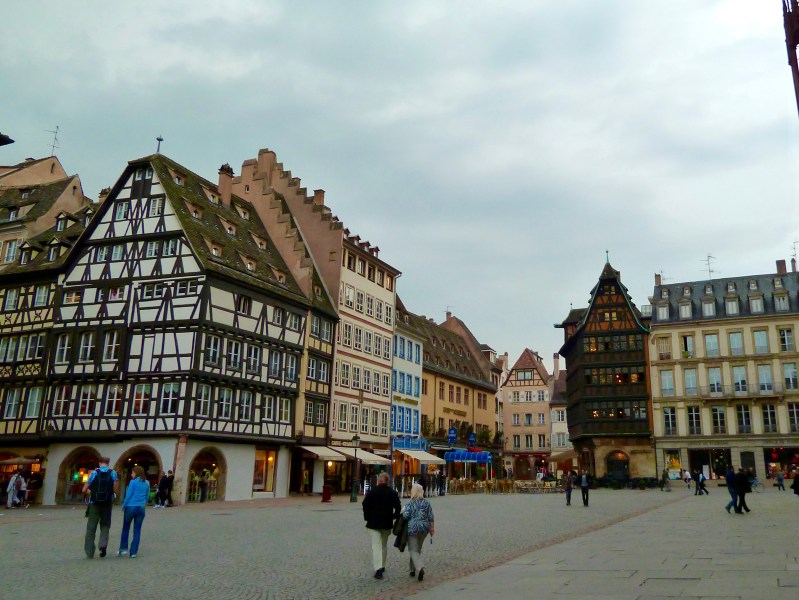
The site of the Cathedral of Strasbourg is one of the main squares of the city and is the site of several notable buildings:
- At No. 10, the former renaissance style Pharmacie du Cerf, was the oldest pharmacy in France which now houses the shop culture of the city. At No. 16 is one of the most famous houses of Strasbourg, home Kammerzell, built in 1571 in the Renaissance style.
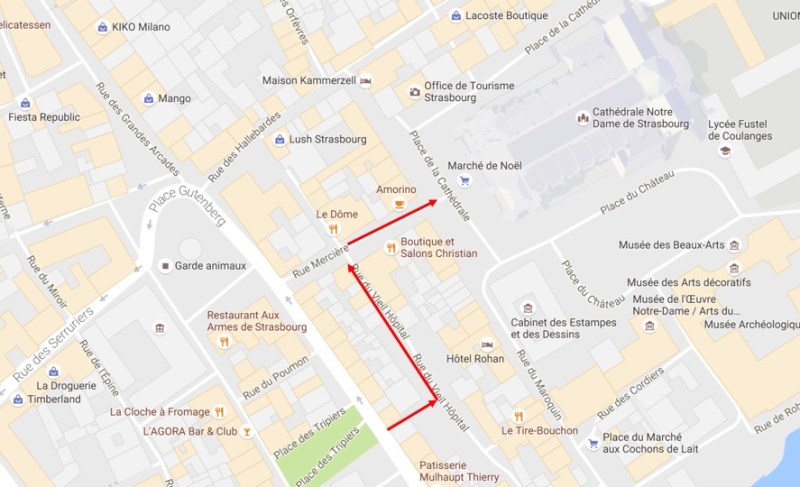
Directions: From Place de Trippiers, walk through the path in the building across from Rue du Vieux Marché aux Poissons. Take a left on Rue du Vieil Hôpital and a right on Rue Mercière.
Strasbourg Cathedral
Strasbourg Cathedral is a Roman Catholic cathedral that is widely considered to be among the finest examples of high, or late, Gothic architecture. Construction on the church took place from 1176 to 1439. It was the world’s tallest building for 227 years, from 1647 (when the spire of St Mary’s Church in Straslund burned down) to 1874. Today it is the sixth-tallest church in the world and the highest extant structure built entirely in the Middle Ages. The cathedral is visible far across the plains of Alsace and can be seen from as far off as the Vosges Mountains or the Black Forest on the other side of the Rhine. Sandstone from the Vosges used in construction gives the cathedral its characteristic pink hue.
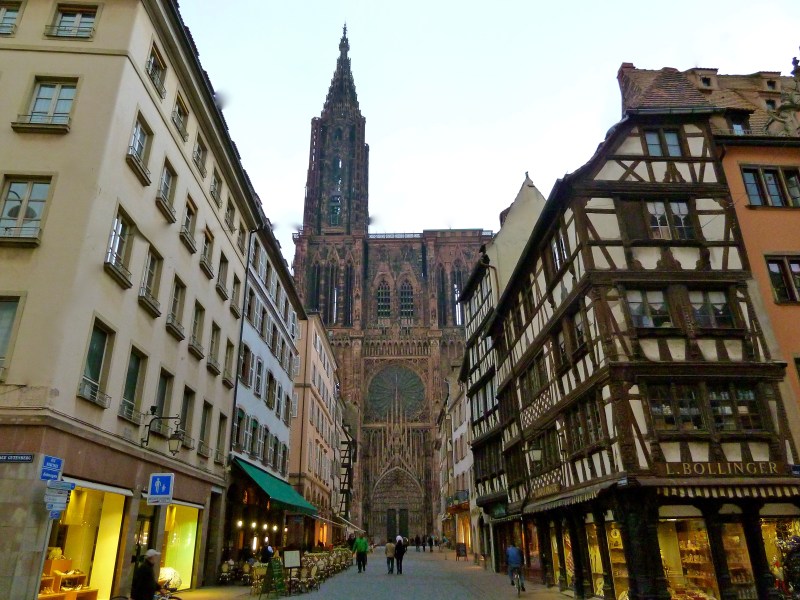
Directions: Strasbourg Cathedral is located at Place de la Cathedrale.
Palais Rohan
The Rohan Palace (French: Palais Rohan) is the former residence of the prince-bishops and cardinals of the House of Rohan, an ancient French noble family originally from Brittany, and is a major architectural, historical and cultural landmark in the city. Built in the 1730s next to Strasbourg Cathedral, it is considered a masterpiece of French Baroque architecture and has hosted a number of illustrious guests since its completion in 1742. Reflecting the history of Strasbourg and of France, the Palais was owned in turn by the nobility, the municipality, the monarchy, the State and the university. Its very architectural and iconographic conception, realised notably through the statues and reliefs of the façades, was intended to express the return of Catholicism to a city which had been dominated by Protestantism for the previous two centuries.
Since the end of the 19th century the Palais has been home to three of Strasbourg’s most important museums: the Archaeological Museum (Musée archéologique, basement), the Museum of Decorative Arts (Musée des arts décoratifs, ground floor) and the Museum of Fine Arts (Musée des beaux-arts, first and second floor).

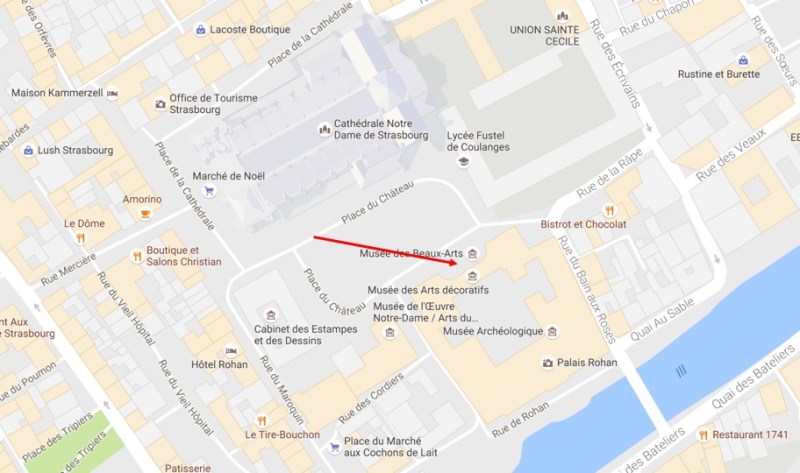
Directions: From Strasbourg Cathedral, walk across Place du Château.
 Eternal Horizon