Starting point: Document Center Museum
The Documentation Center Nazi Party Rallying Grounds (German: Dokumentationszentrum Reichsparteitagsgelände) is a museum in the north wing of the unfinished remains of the Congress Hall of the former Nazi party rallies. Its permanent exhibition “Fascination and Terror” is concerned with the causes, connections, and consequences of Nazi Germany. Topics that have a direct reference to Nuremberg are especially taken into account.
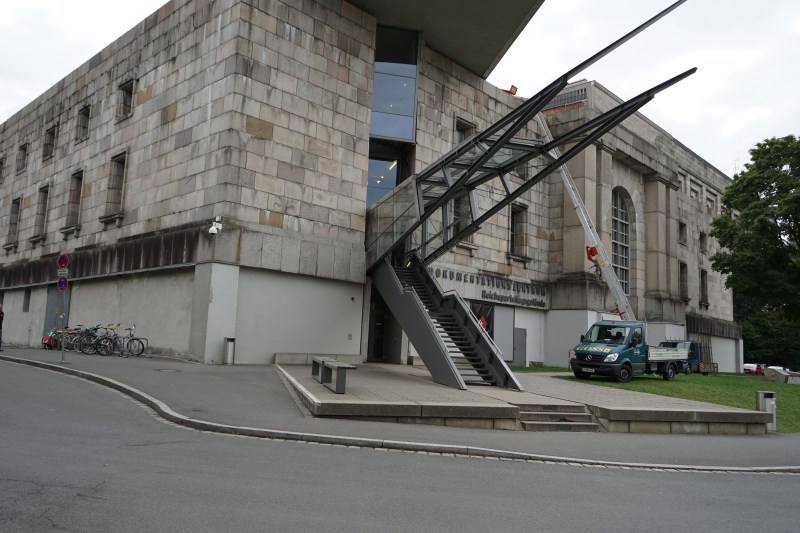
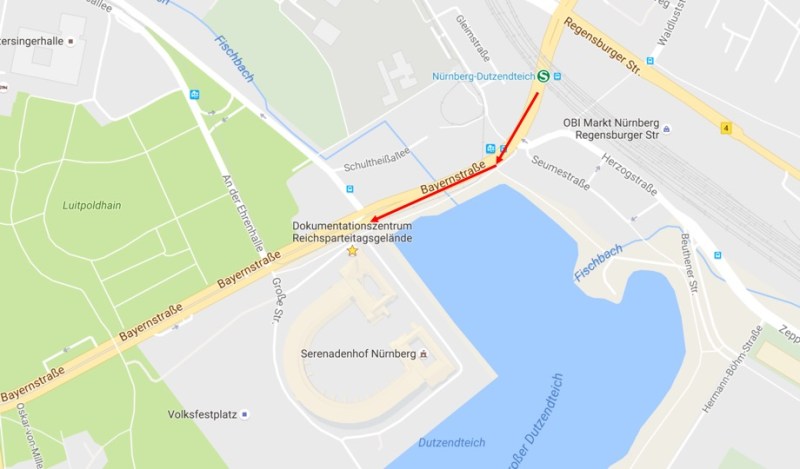
Directions: Take the S2 commuter train to Nürnberg-Dutzendteichand walk on Bayernstrasse to the museum.
Museumsbrucke

Directions: Take the S2 commuter train to Nürnberg Hauptbahnhof. Take the U1 subway stop to Lorenzkirche. Walk north on Königstraße.

Frauenkirche
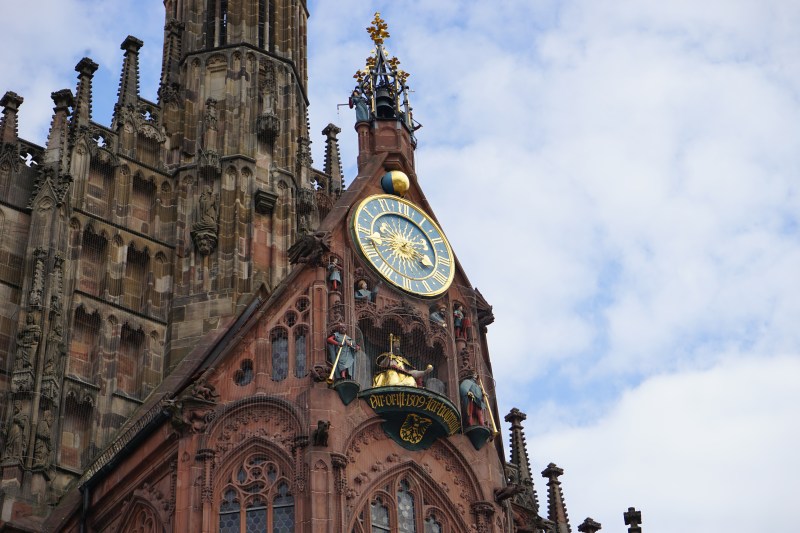
The Frauenkirche (English: Church of Our Lady) is a church on the eastern side of Nuremberg’s main market. An example of brick Gothic architecture, it was built on the initiative of Charles IV, Holy Roman Emperor between 1352 and 1362. The church contains many sculptures, some of them heavily restored. Numerous works of art from the Middle Ages are kept in the church.
One of the most notable features of the church is the Männleinlaufen, a mechanical clock that commemorates the Golden Bull of 1356. The clock was installed in the church in 1506. The Holy Roman Emperor is shown seated with the prince-electors surrounding him. The clock mechanism is activated at midday, a bell is rung to start the sequence followed by the trumpeters and drummer. Then there is a procession of the electors around the figure of the Holy Roman Emperor.
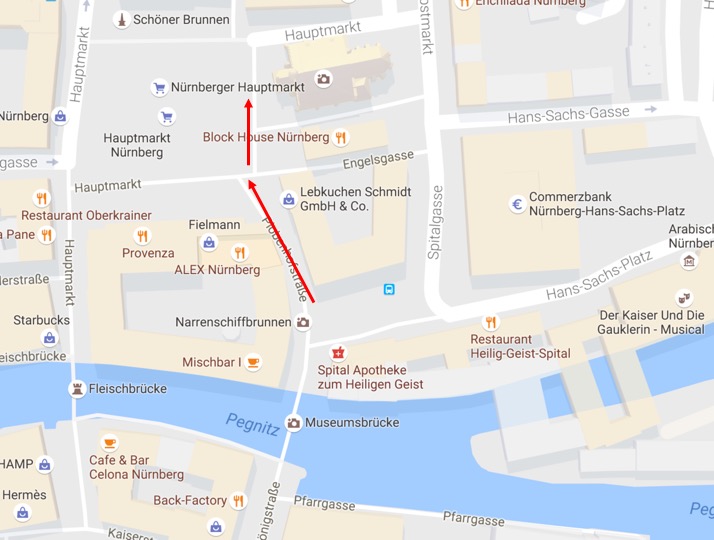
Directions: Continue across Museumsbrücke and walk on Plobenhofstraße. The church is on the right side of Hauptmarkt.
Hauptmarkt
Colourful market stands with fresh fruit and vegetables, bright flowers, crispy bread and other treats. On weekdays at the Nuremberg Hauptmarkt you can buy regional and international specialities.
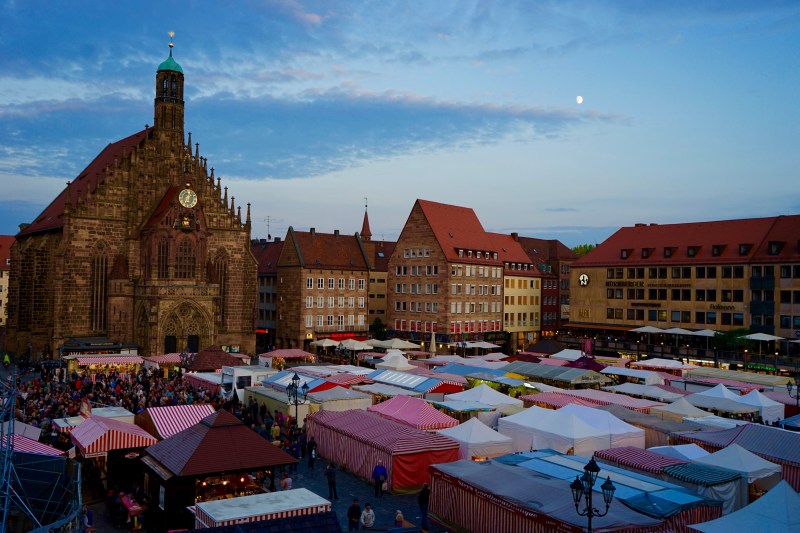
Directions: The hauptmarkt is located outside the Frauenkirche.
St. Sebaldus Church
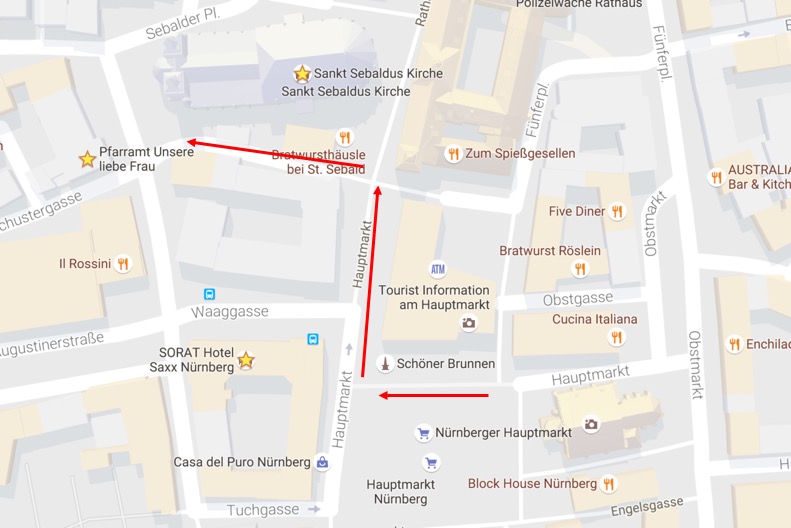
St. Sebaldus Church (German: Sebalduskirche) is a medieval church built between 1225 and 1275. It is located at the Albrecht-Dürer-Platz, in front of the old city hall. It takes its name from Sebaldus, an 8th-century hermit and missionary and patron saint of Nuremberg. It has been a Lutheran parish church since the Reformation.

Directions: Walk to the northwest corner of the Hauptmarkt and take a right. Take a left on Schulgasschen.
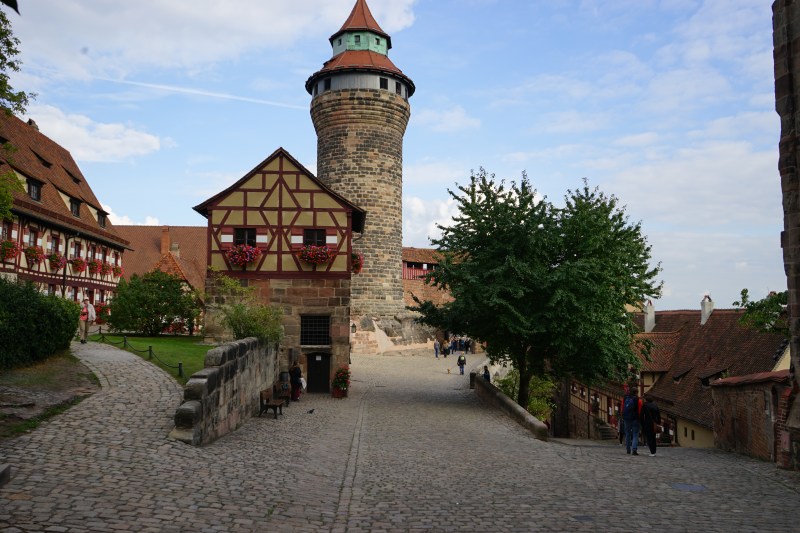
Imperial Castle
Nuremberg Castle (German: Nürnberger Burg) is a historical building on a sandstone rock in the north of the historical city of Nuremberg. It comprises three sections: the Imperial castle (Kaiserburg), some buildings of the Burgraves of Nuremberg (Burggrafenburg), and the municipal buildings of the Imperial City at the eastern site (Reichsstädtische Bauten). The castle, together with the city walls, is considered to be one of Europe’s most formidable medieval fortifications. The castle first appears in documents in 1105.
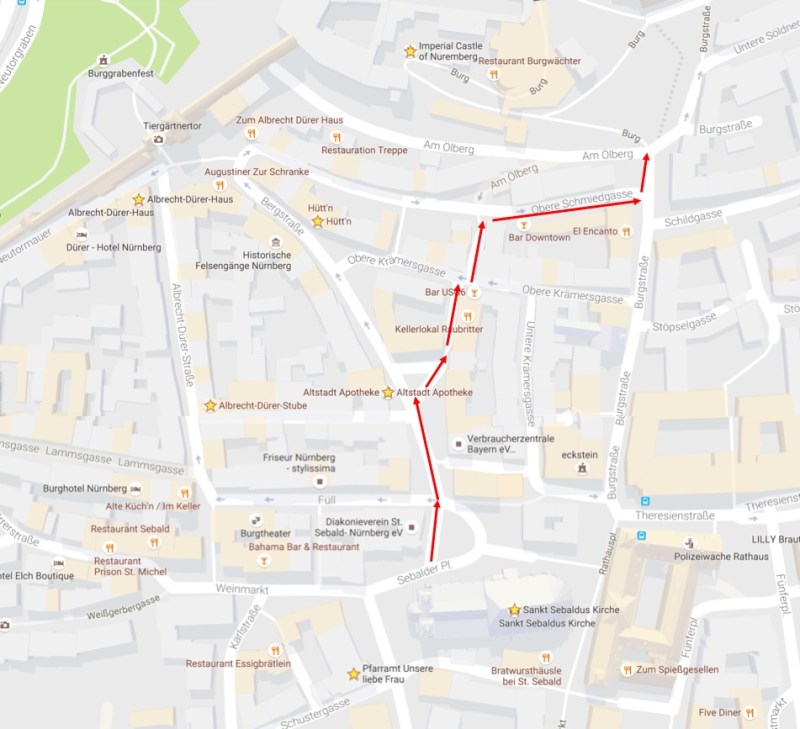
Directions: From Sebalder Platz, walk north on Albrecht-Dürer-Platz. At the fork, veer right to Untere Schmiedgasse. Take a right on Obese Schmiedgasse and a left on Burgstraße.
 Eternal Horizon