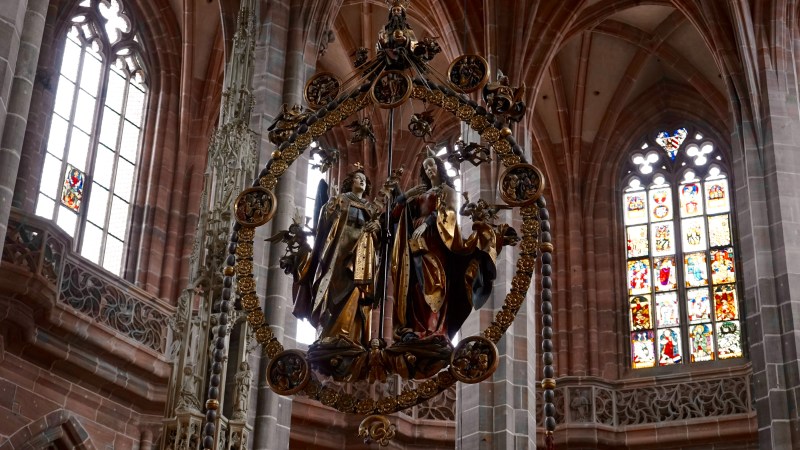
Starting Point: St Lorenz Church
St. Lorenz (St. Lawrence) is a medieval church dedicated to Saint Lawrence. The nave of the church was completed by around 1400. In 1439, work began on the choir in the form of a hall church in the late German Sondergotik style of Gothic architecture. The choir was largely completed by 1477.

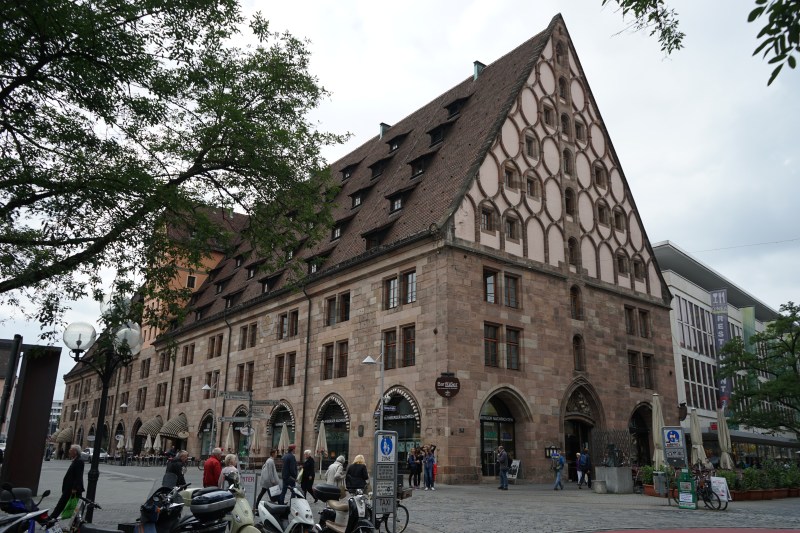
Mauthalle
Mauthalle was first built as a grain and salt storehouse from 1498 – 1502. Starting in 1572 it served as the imperial city weigh house and customs house. It was converted to commercial shops and offices in 1897 and 1898.
Directions: Leave St. Lorenz Church and take a left on Königstraße.

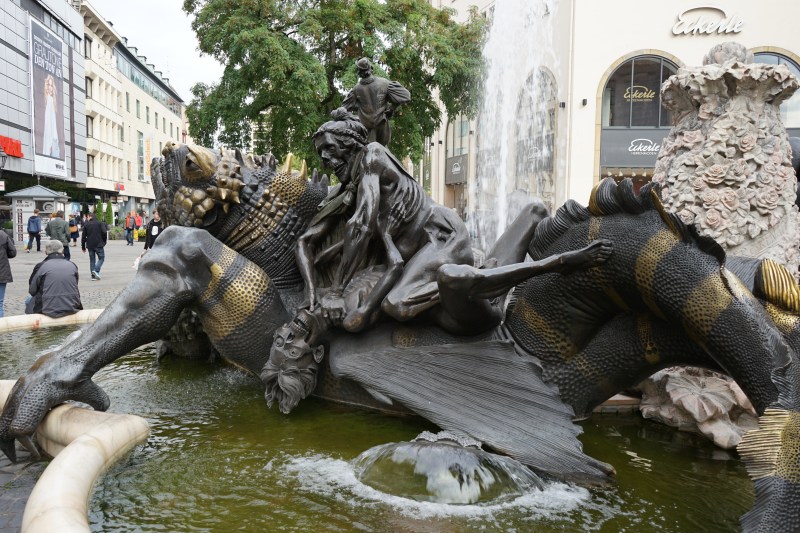
Marriage Merry-Go-Round Fountain
Completed in 1981, the statuary fountain was put in place to cover a subterranean shaft. The artist’s design seems to communicate his less than sunny view of married life. The statue consists of a rough circle of visceral male and female figures that represent various points in a couple’s life. There is the sweet and optimistic dating phase where the figures seem fairly at peace, but then things take a surreal and dark turn. From there further scenes depict the couple getting old and frail or fat respectively, before they both die.
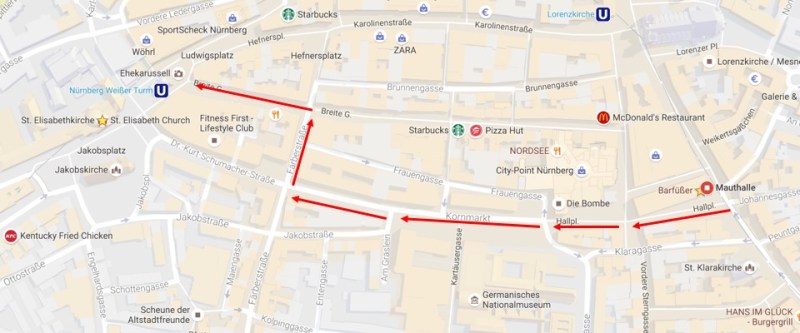
Directions: From Königstreue, take a left on Hallplatz and continue forward as it becomes Kornmarkt. Turn right on Färberstraße and left on Hefnersplatz.
St Elizabeth Church
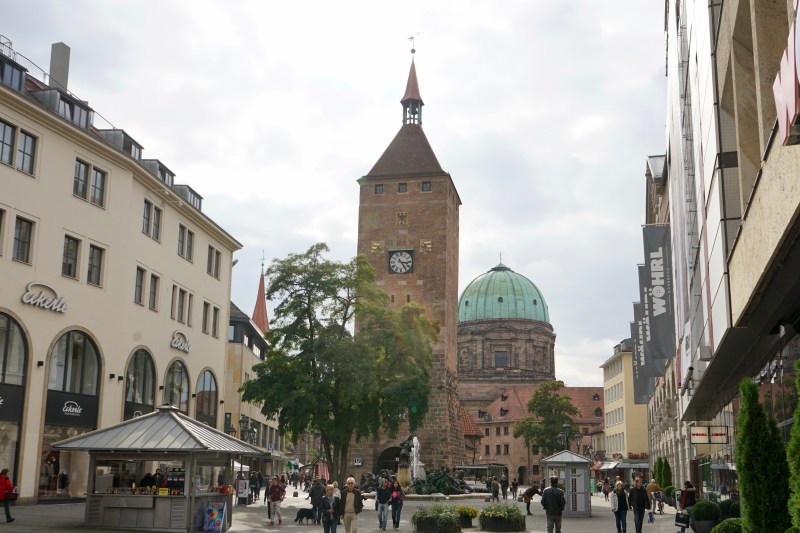
The chapel was dedicated to Elizabeth of Hungary in 1235. After the Reformation, this was the only Roman Catholic church in the Protestant city of Nuremberg. It soon became inadequate for its congregation, and the church entered into protracted negotiations with the city magistrate, which lasted from 1718 to 1780. Finally agreement was reached for a new church, and the old one was demolished in 1784. The foundation stone was laid on 19 May 1785. Eventually topping off was completed in 1802 and in 1803 the dome was crowned with a golden cross. In 1806 the church was secularised. On 27 January 1885, the Roman Catholic Archdiocese of Bamberg purchased the church, and further work was done to complete the church to the original plans. It was eventually completed in 1903.
Directions: From the fourtain, continue on Ludwigplatz.

Further Tor
The city walls of old city Nürnberg are the defensive mechanism surrounding the city. Construction started in the 12th Century and ended officially in the 16th Century, and they run for 5 kilometers (about 4 kilometers still standing) around the old town.

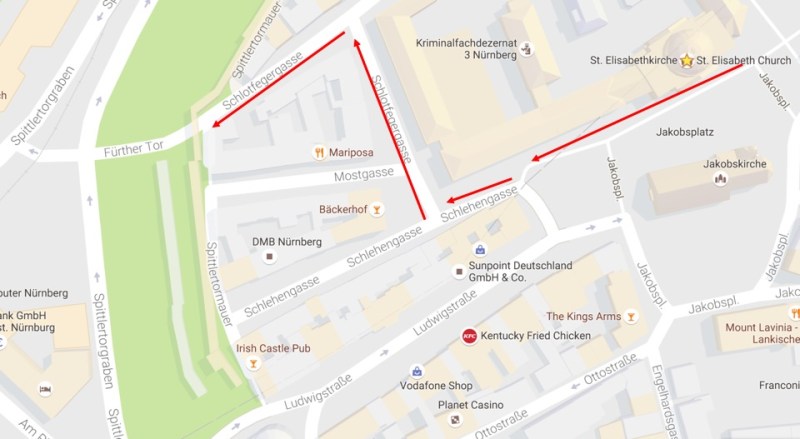
Directions: From the church, walk west on Jakobsplatz, which becomes Schlehengasse. Turn right on Schlotfegergasse , which turns to the left.
Nuremberg Trial Memorial
The Nuremberg Palace of Justice is a building complex constructed from 1909 to 1916. The building was the location of the Nuremberg trials that were held from 1945 to 1949 for the main surviving German war criminals of World War II. The Palace of Justice was chosen as the site of the trials because it was almost undamaged, offered sufficient space and included a large prison complex. The choice of the city of Nuremberg was symbolic as the Nazis had held large Nuremberg Rallies in the city.
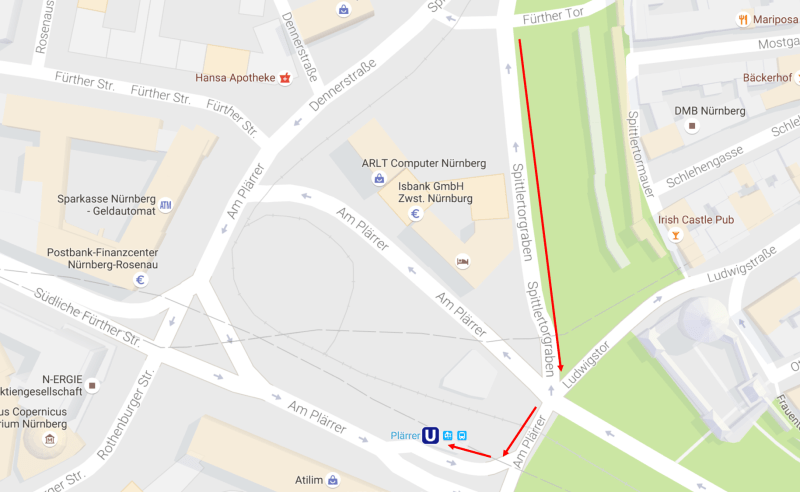
Directions: From Further Tor, turn left on to Spittlertorgraben. Veer left at Am Plarrer and enter the subway at the Plarrer stop. From here, take the U1 to the Brenschanze stop. Walk west on Further Strasse and veer to the right at the fork in the road. Turn right on Bärenschanzstraße.

 Eternal Horizon