Starting Point: Theatinerkirche
The Theatine Church is a Catholic church built from 1663 to 1690. It was founded by Elector Ferdinand Maria and his wife, Henriette Adelaide of Savoy, as a gesture of thanks for the birth of the long-awaited heir to the Bavarian crown, Prince Max Emanuel, in 1662. Its Mediterranean appearance and yellow coloring became a well known symbol for the city and had much influence on Southern German Baroque architecture.
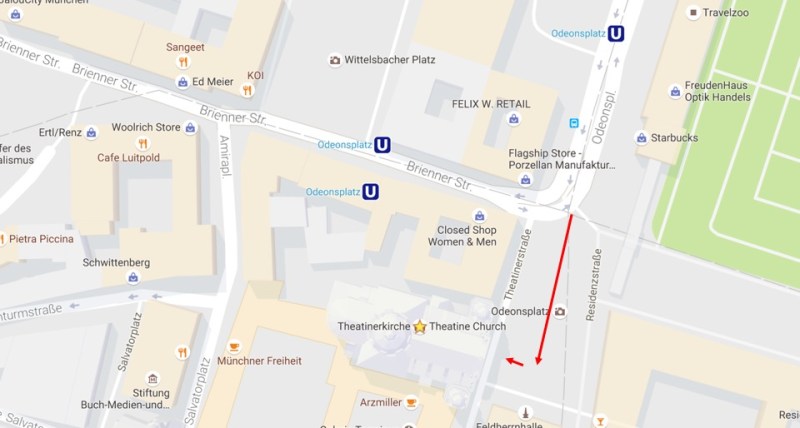
Directions: Take either the U3 line, U4 line, U5 line, or U6 line to Odeonnsplatz. Theatinerkirche is located on the west side of Odeonsplatz.
Residenz
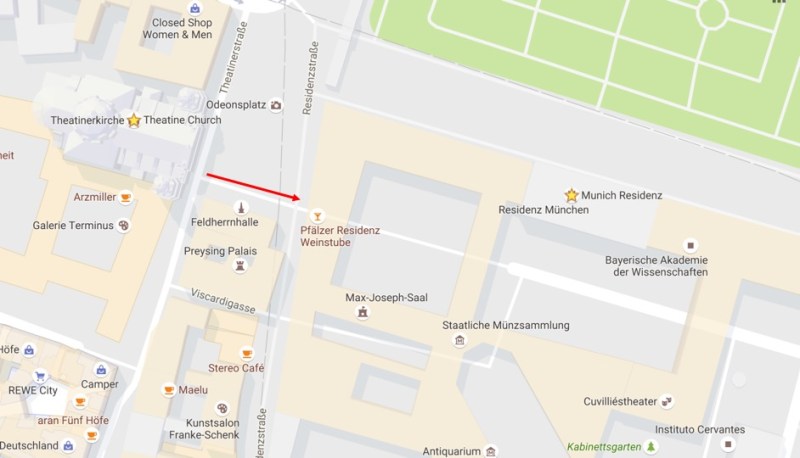
The Munich Residenz is the former royal palace of the Bavarian monarchs of the House of Wittelsbach. The Residenz is the largest city palace in Germany and is today open to visitors for its architecture, room decorations, and displays from the former royal collections. The complex of buildings contains ten courtyards and displays 130 rooms.

Directions: The Residenz is located on the east side of Odeonsplatz.
Hofgarten
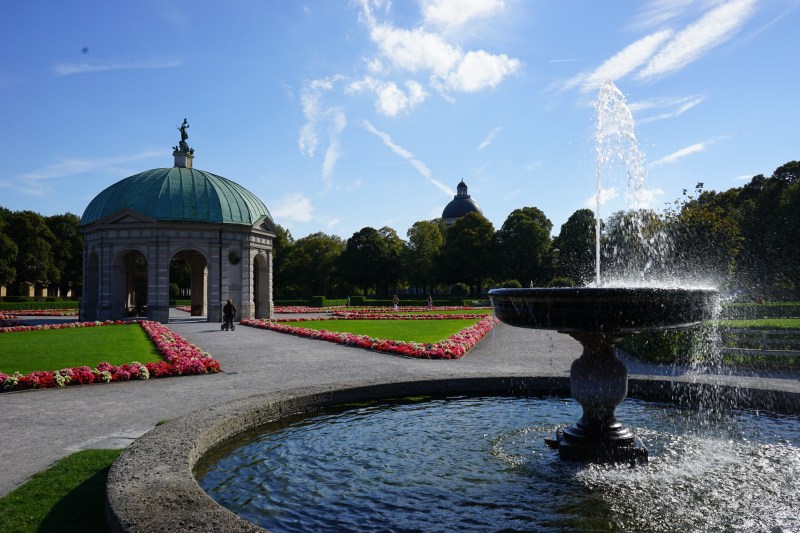
The garden was built in 1613–1617 by Maximilian I, Elector of Bavaria as an Italian style Renaissance garden. In the center of the garden is a pavilion for the goddess Diana, built in 1615. A path leads from each of the eight arches. On the roof of the Diana pavilion is the replica of a sculpture of Bavaria, created in 1623. The original is in the Kaisersaal of the Residenz.
Facing the Hofgarten on the east side is the Bavarian Staatskanzlei (“State Chancellery”), housed in the former Army Museum, with the addition of glass wings left and right of the original building. The repurposed building was completed in 1993. A few steps more eastwards the Hofgartenkaserne was located from 1801 to 1899. In front of the Staatskanzlei, the Kriegerdenkmal (“war memorial”) is located, built for commemoration of the Munich people, killed in action in World War I. In the north east corner, a square black granite memorial stands to the White Rose group, whose members were executed for a non violent campaign against Hitler’s regime.
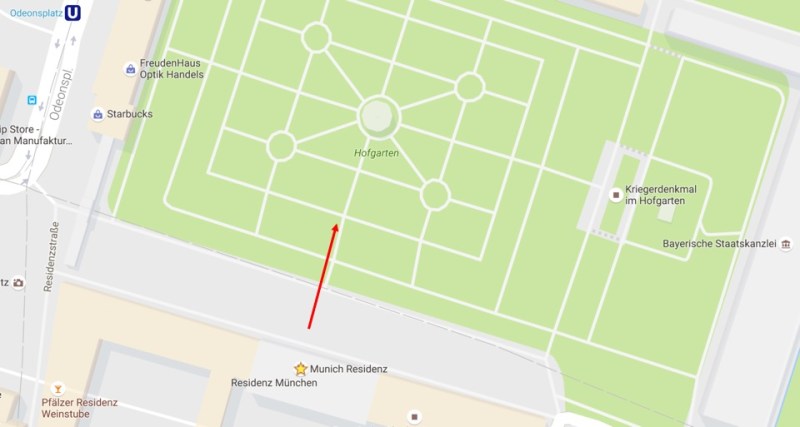
Directions: Hofgarten is located just to the north of the Residenz.
Bavarian National Museum
The Bavarian National Museum (German: Bayerisches Nationalmuseum) is one of the most important museums of decorative arts in Europe and one of the largest art museums in Germany. From the beginning the collection has been divided into two main groups: the art historical collection and the folklore collection. The museum was founded by King Maximilian II of Bavaria in 1855. It houses a large collection of European artifacts from the late antiquity until the early 20th century with particular strengths in the medieval through early modern periods.
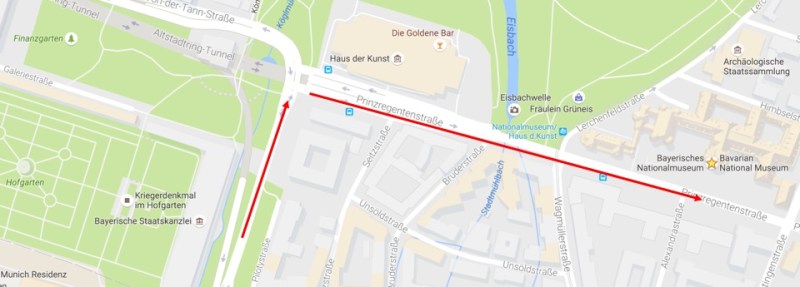
Directions: From Von-der-Tann-Straße, turn right on Prinzregentenstraße.
 Eternal Horizon