Downtown
Starting Point: World Trade Center
The World Trade Center is a partially completed complex of buildings under construction in Lower Manhattan. It is replacing an original complex of seven buildings with the same name on the same site that were damaged or destroyed in the September 11 attacks. The site is being rebuilt with six new skyscrapers, a memorial and museum to those killed in the attacks, and a transportation hub. One World Trade Center is the tallest building in the United States, North America and the Western Hemisphere.
World Trade Center Memorial & Museum
The National September 11 Memorial & Museum commemorate the September 11, 2001 attacks, which killed 2,977 victims, and the World Trade Center bombing of 1993, which killed six. The memorial is located at the World Trade Center site, the former location of the Twin Towers, which were destroyed during the September 11 attacks. It is operated by a non-profit corporation whose mission is to raise funds for, program, own, and operate the memorial and museum at the World Trade Center site. The names of 2,983 victims are inscribed on 76 bronze plates attached to the parapets of the walls of the memorial pools: 2,977 killed in the September 11 attacks and six killed in the 1993 World Trade Center bombing. The names are arranged according to an algorithm, creating “meaningful adjacencies” based on relationships—proximity at the time of the attacks, company or organization affiliations. The September 11 Museum includes 23,000 images, 10,300 artifacts, nearly 2,000 oral histories of those killed – mostly provided by friends and families – and over 500 hours of video.

Directions: Take the 4 or 5 to Fulton Street, the R or W to Cortland Street, or the E to Chambers Street.

1 World Trade Center
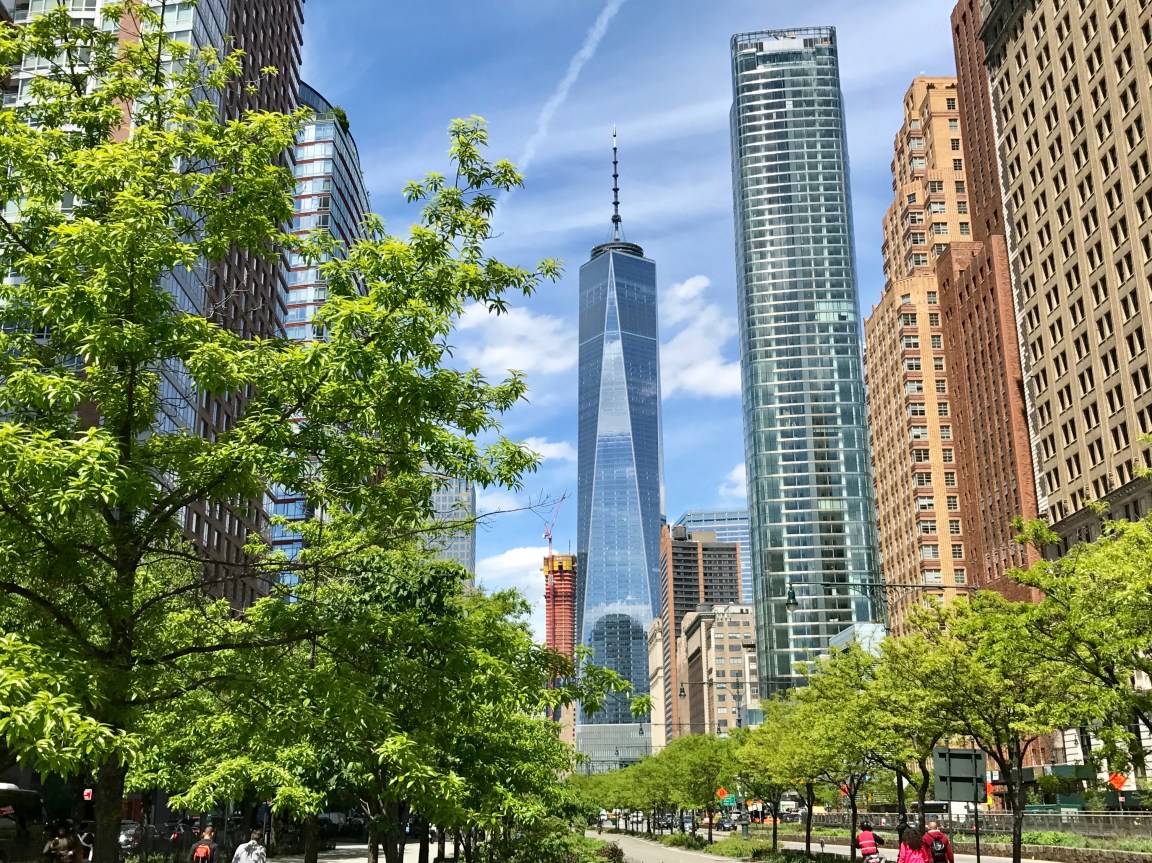
Directions: From the World Trade Center memorial, walk north towards WTC1. Enter on the west side of the building.

World Trade Center Oculus
World Trade Center is a terminal station on the PATH system. Located within the World Trade Center, it is served by the Newark–World Trade Center line at all times and the Hoboken–World Trade Center line on weekdays.
The station was originally opened in 1909, but was torn down, rebuilt, and re-opened in 1971. Following the September 11, 2001 attacks, a temporary station opened in 2003. The main station house, the Oculus, opened on March 4, 2016, and the terminal was renamed the World Trade Center Transportation Hub, or World Trade Center for short.

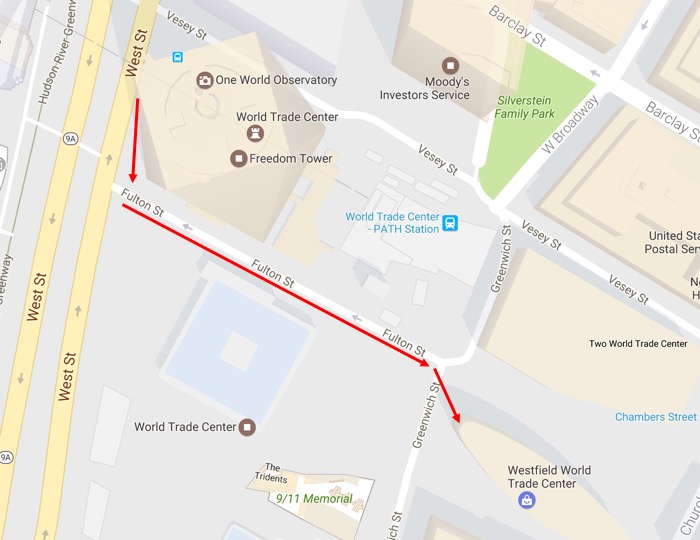
Directions: From World Trade Center 1, walk east on Fulton, past the memorial pools. Cross Greenwich Street and enter here.
St Paul’s Chapel
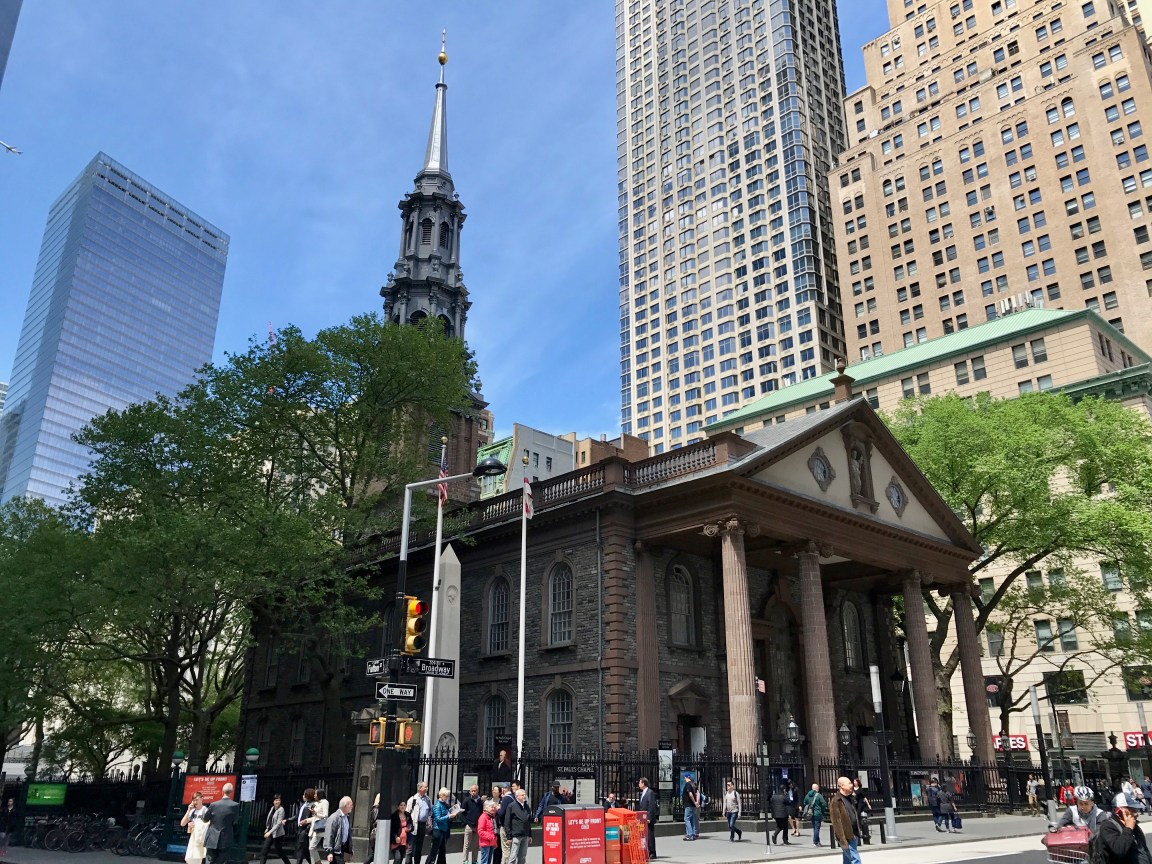
St. Paul’s Chapel is an Episcopal chapel located at 209 Broadway, between Fulton Street and Vesey Street, in Lower Manhattan. Built in 1766, it is the oldest surviving church building in Manhattan. The rear of St. Paul’s Chapel faces Church Street, opposite the east side of the World Trade Center site. After the attack on September 11, 2001, which led to the collapse of the twin towers of the World Trade Center, St. Paul’s Chapel served as a place of rest and refuge for recovery workers at the WTC site. For eight months, hundreds of volunteers worked 12-hour shifts around the clock, serving meals, making beds, counseling and praying with fire fighters, construction workers, police and others.
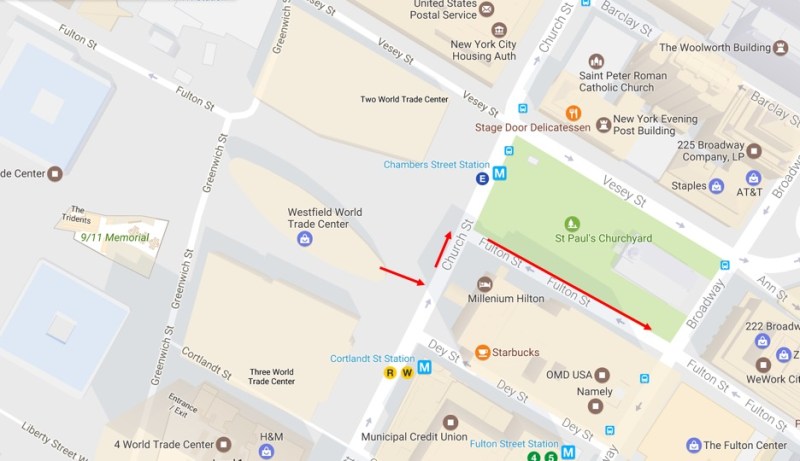
Directions: From the oculus, turn left on Church Street. Sometimes the back gate is open and you can enter the churchyard here. If it is closed, turn on Fulton Street and enter the church on Broadway.
City Hall
New York City Hall is located at the center of City Hall Park in the Civic Center area of Lower Manhattan. It was constructed from 1803 to 1812. The building is the oldest city hall in the United States that still houses its original governmental functions.

Directions: After exiting St. Paul’s Church, turn left on Broadway and walk up to City Hall.

Brooklyn Bridge
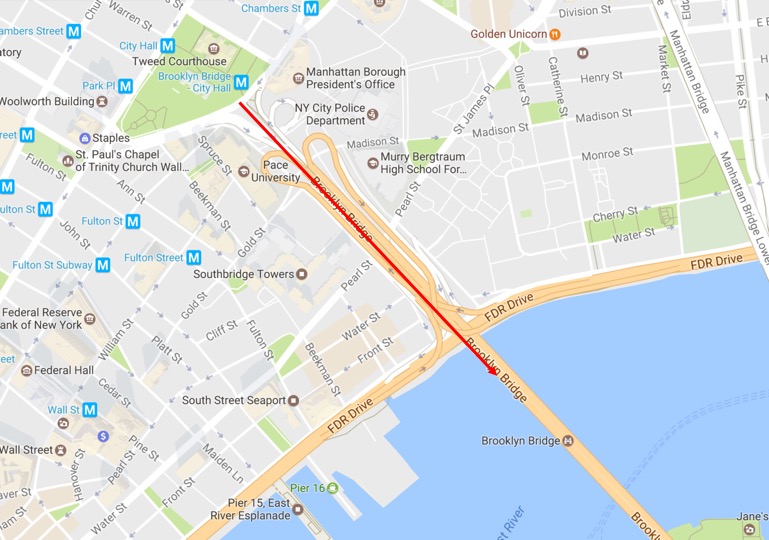
The Brooklyn Bridge is a hybrid cable-stayed/suspension bridge in New York City and is one of the oldest bridges of either type in the United States. Completed in 1883, it connects the boroughs of Manhattan and Brooklyn by spanning the East River. It has a main span of 1,595.5 feet and was the first steel-wire suspension bridge constructed.

Directions: From City Hall, cross Centre Street. At this point, you can walk as far as you would like on Brooklyn Bridge. Be sure to stay on the side for pedestrians. The bicyclists on this bridge can be aggressive.
Chinatown
Columbus Park
Columbus Park was formerly known as Mulberry Bend Park, Five Points Park and Paradise Park. During the 19th century, this was the most dangerous ghetto area of immigrant New York, as portrayed in the book and film Gangs of New York. Back then, the park’s site was part of the Five Points neighborhood.

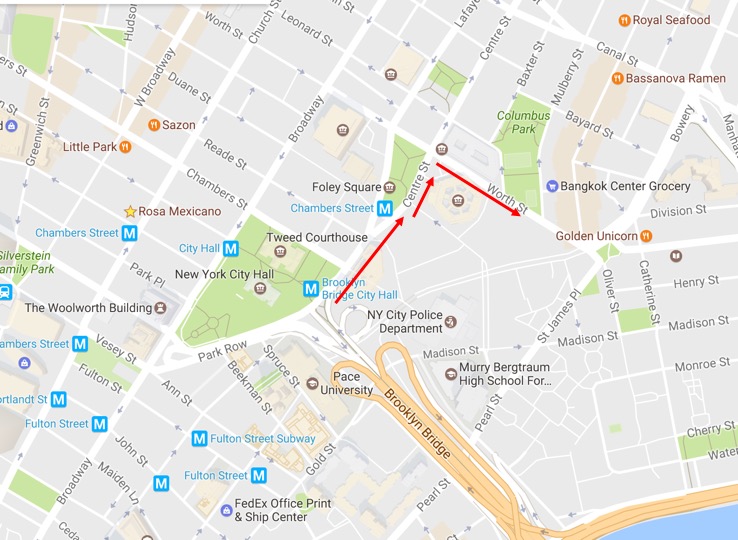
Directions: After leaving Brooklyn Bridge, turn right on Centre Street and take another right on Worth Street.
Pell Street and Doyers Street
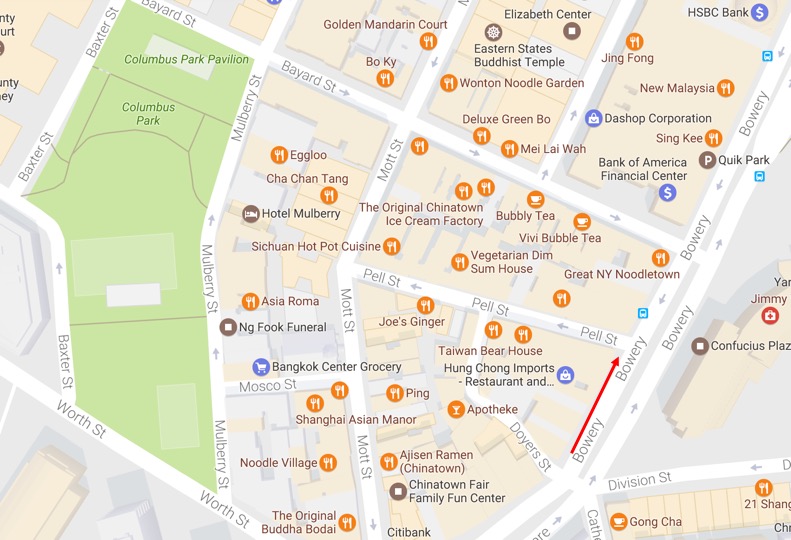
Two streets in Chinatown with a number of bars and restaurants. This is your first stop in Manhattan’s Chinatown, which is home to the largest and oldest enclaves of Chinese people in the Western Hemisphere.

Directions: From Columbus Park, walk down Mosco Street. Turn left on Mott Street. Then, turn right on Pell Street, and take another right on Doyers Street.

Edward Mooney House
The Edward Mooney House located at 18 Bowery at the corner of Pell Street. It was built between 1785 and 1789 for wealthy butcher Edward Mooney on land he purchased after it was confiscated from British Loyalist James De Lancey. The brick house was built in a mixture of Georgian and Federal styles, and is the earliest remaining townhouse in the Early Federal style in the city. In 1807 the size of the house was doubled by an addition to the rear. The house would be used as a private residence until the 1820s after which it has served at various times as a hotel, brothel and saloon.
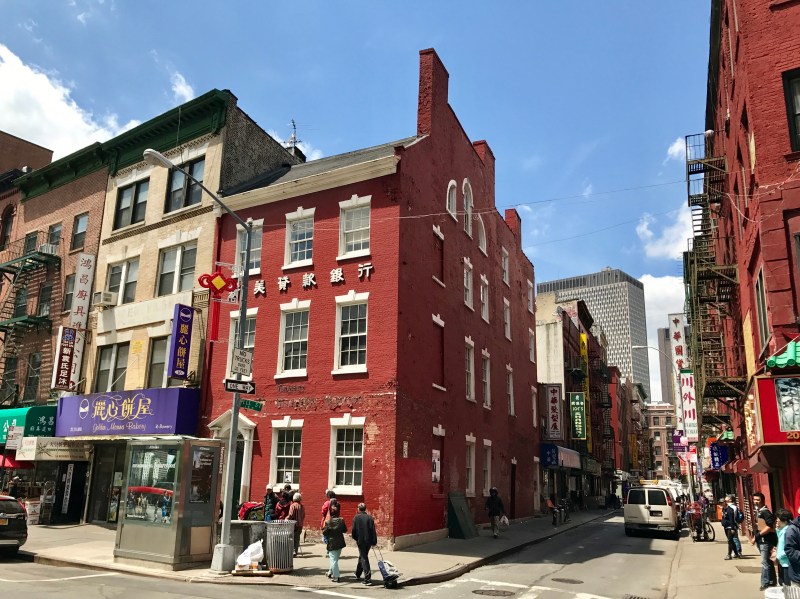
Directions: From Doyers Street, turn left on Bowery Street. The Edward Mooney House is located at the corner of Bowery and Pell.
Mahayana Buddhist Temple
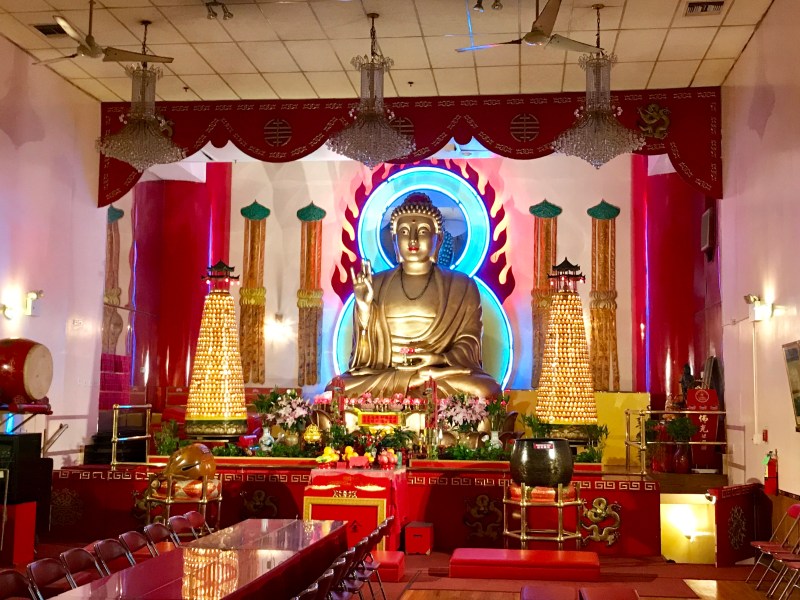
Directions: Continue up Bowery Street. Cross Canal Street and turn right.

Manhattan Bridge Entrance
In 1910, a year after the bridge opened, the architectural firm Carrère and Hastings drew up preliminary plans for an elaborate grand entry to the bridge on the Manhattan side, as part of the “City Beautiful” movement. Construction began that year, and plans were finalized in 1912. The arch and colonnade were completed in 1915.
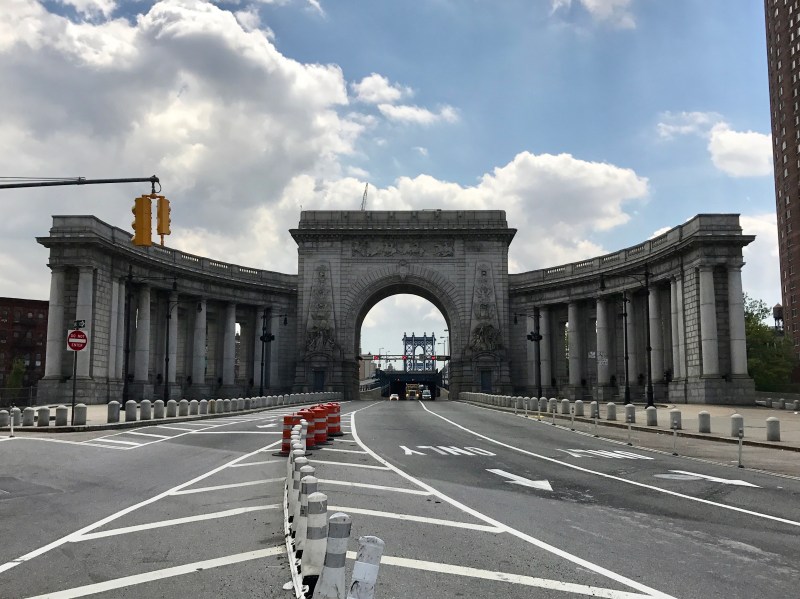
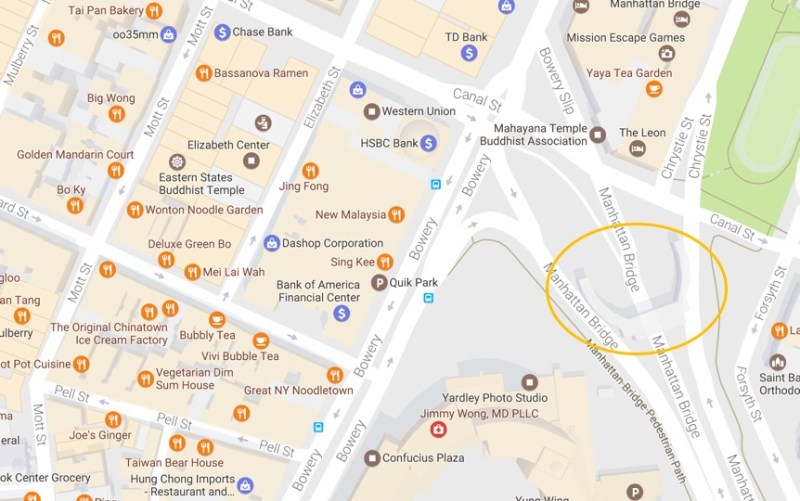
Directions: From the Mahayana Buddhist Temple, look to the right.
Canal Street
Major street in Chinatown. There are a number of shops on this street.

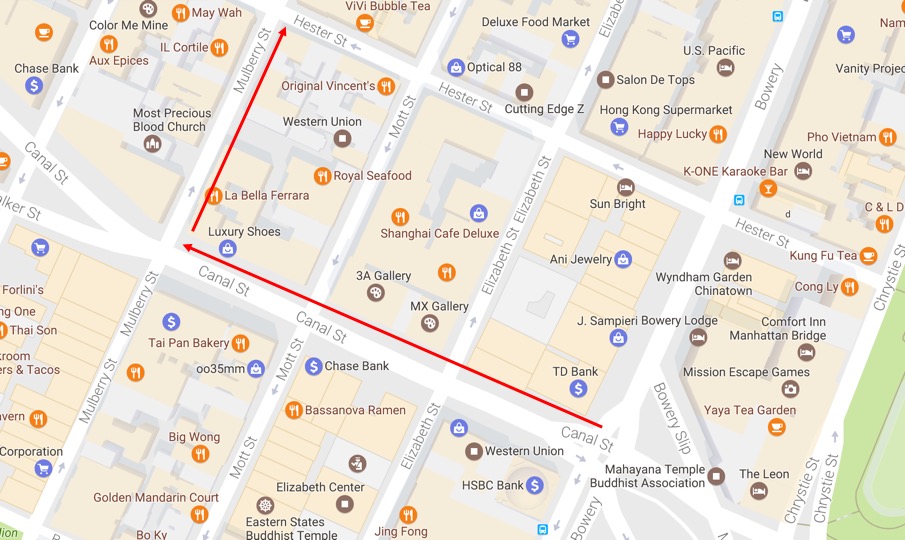
Directions: After exiting the Mahayana Buddhist Temple, turn left on Canal.
Little Italy
Little Italy is a neighborhood in lower Manhattan, once known for its large population of Italian Americans. Today the neighborhood consists of only a few Italian stores and restaurants.

Directions: From Canal Street, turn left on Mulberry.
Old St. Patrick’s Cathedral
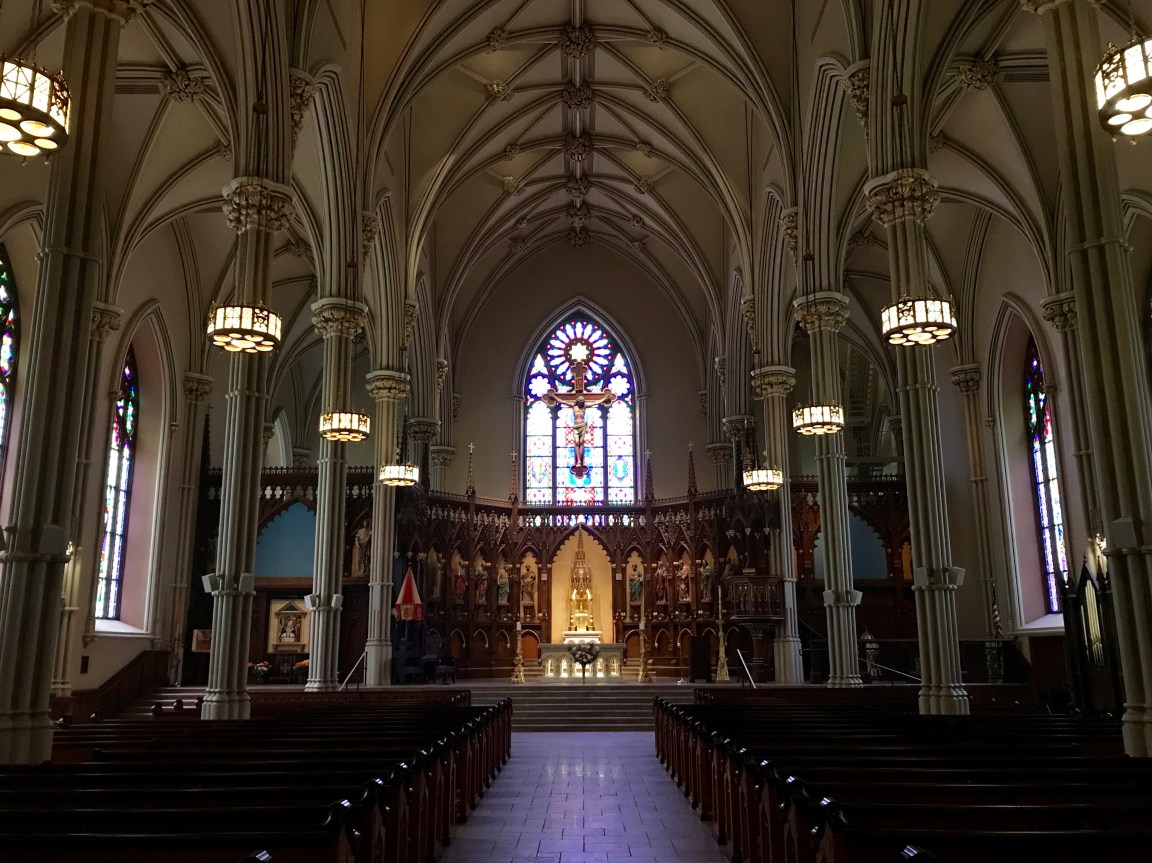
The Basilica of Saint Patrick’s Old Cathedral, or Old St. Patrick’s, was built between 1809 and 1815. It was the seat of the Roman Catholic Archdiocese of New York until the current Saint Patrick’s Cathedral opened in 1879.
Directions: From Mulberry, turn right on Prince. Then turn left on Mott.

Nearby Food & Drink
 Eternal Horizon